


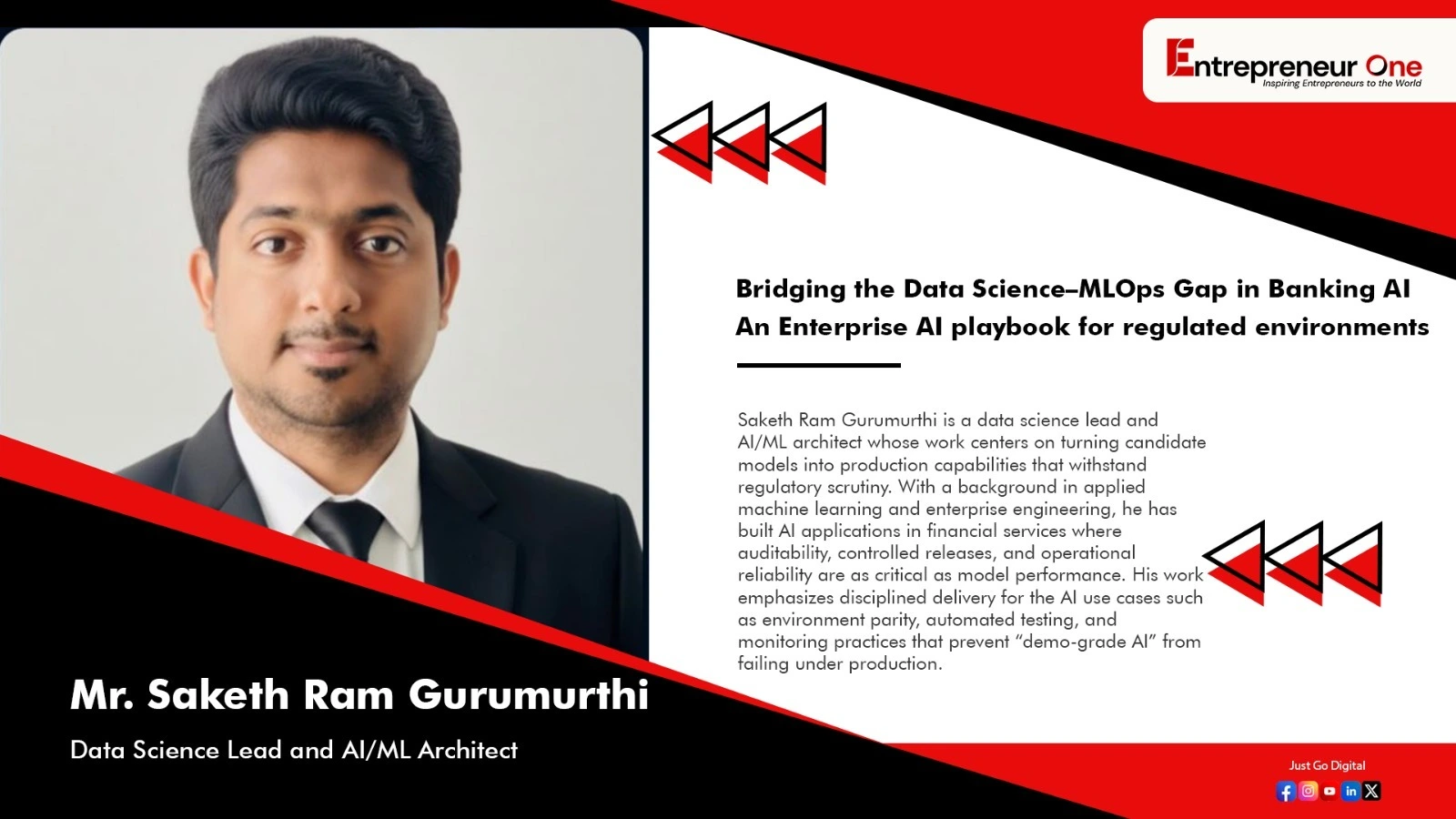
Saketh Ram Gurumurthi is a data science lead and AI/ML architect whose work centers on turning candidate models into production capabilities that withstand regulatory scrutiny. With a background in applied machine learning and enterprise engineering, he has built AI applications in financial services where auditability, controlled releases, and operational reliability are as critical as model performance. His work emphasizes disciplined delivery for the AI use cases, such as environment parity, automated testing, and monitoring practices that prevent “demo-grade AI” from failing under production.
In modern enterprise environments, AI initiatives often begin with promising prototypes. Models perform well in controlled settings, dashboards demonstrate potential, and early results inspire optimism. The true challenge emerges when those models must operate under real-world conditions – on production data, with strict regulatory requirements, and under the pressure of operational accountability. For Mr. Saketh Ram Gurumurthi, this is the moment many AI programs stall: not because the model is weak, but because the system around the model was never engineered for production.
Gurumurthi’s work centers on a simple distinction: the distinction between a strong model and a strong capability lies in system design. In regulated financial institutions, a model’s offline performance is only a small part of success. In his approach, systems must be explainable, reproducible, auditable, and continuously monitored to maintain trust and withstand scrutiny. He frames the “data science vs. MLOps gap” as rarely a people problem; it is usually an engineering-design problem created by late-stage handoffs, inconsistent environments, and missing operational guardrails.
The flagship example Gurumurthi describes is a production workflow that originally took four days to complete end-to-end. The workflow consisted of 15 dependent sub-tasks, and the duration was not just inconvenient, as it constrained operations and limited how quickly decisions could be refreshed. The objective was not cosmetic optimization; it was a step-change improvement that would make the system operationally usable while still meeting governance expectations.
He says the team reduced the end-to-end runtime from 96 hours to 7 hours, cutting total processing time by approximately 92.7% – a roughly 13.7× speedup. Importantly, Mr. Gurumurthi stresses that the improvement was achieved without breaching the customer SLA, because speed in regulated workflows is meaningless if it comes at the expense of reliability, controls, or predictable delivery behavior. The runtime reduction was implemented without compromising governance: validation gates, audit logging, and deterministic reruns remained in place.
Latency was the second constraint that demanded production-grade engineering. Mr. Gurumurthi describes an AI response path that initially took around 15 seconds, which made real-time use cases impractical. He says the system was re-engineered to bring latency down to approximately 200 milliseconds, shifting it from “technically functional” to “operationally viable.” He notes that this is where teams often misdiagnose the issue, as this is where many AI teams misdiagnose the issue: they keep tuning the model while the real bottleneck is in the serving stack – memory management, scheduling, batching, preprocessing overhead, and inefficient hardware execution.
Gurumurthi attributes performance at this level to engineering the entire serving pipeline, not just the model. He describes the approach as building a production spine that includes hardware-aware execution, memory efficiency, decoding strategy, and traffic-shaped request handling. In practical terms, he illustrates how GPU-optimized kernels can remove major inefficiencies by aligning computation with how the hardware actually executes. He also points to paged attention-style memory management as critical in preventing GPU memory waste and maintaining stable performance under load. In simpler terms, the serving stack (not the model) was redesigned for efficiency.
He adds that model compilation and decoding strategy were just as important as raw compute. Mr. Gurumurthi says compiling the model execution path to run natively on the target hardware can eliminate significant overhead. He also highlights speculative decoding as a high-impact approach: instead of generating one token at a time, a smaller model proposes candidate tokens and the main model verifies them in batches, reducing end-to-end generation time while keeping outputs controlled.
The remaining gains, he says, came from engineering the system around real traffic. His production playbook includes continuous batching so the system does not idle while waiting for ideal batch sizes, and asynchronous preprocessing so the next inputs are prepared while the model is still working. He also stresses practical production tactics that are often ignored in early prototypes: request-level caching for repeated queries, model warm-up to eliminate cold-start behavior, and quantization to reduce weight precision while preserving acceptable quality. Gurumurthi’s point is that none of these are optional once the system becomes an operational dependency; they are the difference between a demo and a capability.
He argues that performance work is meaningless if it breaks governance. That is why Mr. Gurumurthi emphasizes environmental parity and promotion of discipline as a defining requirement in regulated environments. He emphasizes production-parity validation: verifying permissions and data contracts in lower environments, validating end-to-end behavior in a pre-production environment that mirrors production, and deploying with unit and integration tests and rollback plans. In his view, this discipline is not bureaucracy; it is how teams prevent predictable failures and avoid incident-driven operations.
He argues that performance work is meaningless if it breaks governance. That is why Mr. Gurumurthi emphasizes environmental parity and promotion of discipline as a defining requirement in regulated environments. He emphasizes production-parity validation: verifying permissions and data contracts in lower environments, validating end-to-end behavior in a pre-production environment that mirrors production, and deploying with unit and integration tests and rollback plans. In his view, this discipline is not bureaucracy; it is how teams prevent predictable failures and avoid incident-driven operations.
Mr. Gurumurthi also suggests observability must be treated as part of the product, not an afterthought. He notes that many “model issues” are actually system issues – schema drift, silent data quality degradation, permission mismatches, or pipeline breakages that surface downstream as instability. He recommends monitoring the full chain (pipeline health, data quality and drift signals, model behavior shifts, and business KPIs) so teams can diagnose change with evidence rather than speculation.
Near the end of the story, Mr. Gurumurthi points to external validation that aligns with the kind of delivery discipline described. He notes that recognitions such as Wipro’s “Databricks Banking Partner of the Year (2025)” reflect how financial institutions are increasingly prioritizing AI systems that can be governed, operated, and scaled rather than isolated prototypes. Mr. Gurumurthi’s message is consistent: enterprises do not scale AI by shipping models faster; they scale AI by engineering systems that are safe to run, safe to change, and easy to defend. In regulated environments, he says, it is the outcome of production discipline.
Looking ahead, Gurumurthi’s focus for 2026 is scaling reusable delivery patterns that reduce operational burden and publishing practical, platform-agnostic guidance that helps teams bridge the gap between data science and MLOps without turning the conversation into platform promotion. He also contributes through professional service activities (e.g., reviewing and evaluation roles), and he aims to publish more platform- agnostic frameworks that reflect what enterprise teams face when AI systems break and how leaders prevent that from happening again.
His message to readers is practical: don’t confuse a strong model with a strong capability. Design for production early, treat data as a contract, treat features as reusable assets, and treat monitoring as a first-class requirement. Ultimately, trust is the real product, and production-grade systems are how you earn it.
Across these efforts, a central insight emerges from Gurumurthi’s work: enterprises benefit not from individual models, but from systems that continue working as conditions evolve. By designing for production early, treating data as a contract, features as reusable assets, and elevating monitoring to a first-class requirement, organizations can build AI capabilities and earn trust through production-grade reliability.