

By M. Chandra Mohan
Founder & Chairman & Managing Director
Microcore Research Laboratories India Pvt. Ltd.
Thiruppugazh Biotech Pvt. Ltd.
ABSTRACT
Osteoarthritis (OA) is the most common chronic degenerative joint disorder affecting millions worldwide and is a leading cause of disability among the elderly population. Despite significant advances in pharmacological management, currently available therapies primarily provide symptomatic relief without reversing cartilage degeneration or restoring joint architecture. Long-term use of non-steroidal anti-inflammatory drugs (NSAIDs), corticosteroids, and diacerein-based formulations is frequently associated with gastrointestinal, hepatic, renal, and cardiovascular adverse effects, highlighting the need for safer and more effective alternatives.
Recent advances in biomaterial science have identified Natural Egg Shell Membrane (NESM) as a unique extracellular matrix-derived biomaterial containing multiple collagen types (I, III, V and X), elastin, hyaluronic acid, glycosaminoglycans, glucosamine, and biologically active peptides. Unlike isolated collagen supplements, NESM preserves the natural extracellular matrix architecture, allowing multiple bioactive molecules to function synergistically.
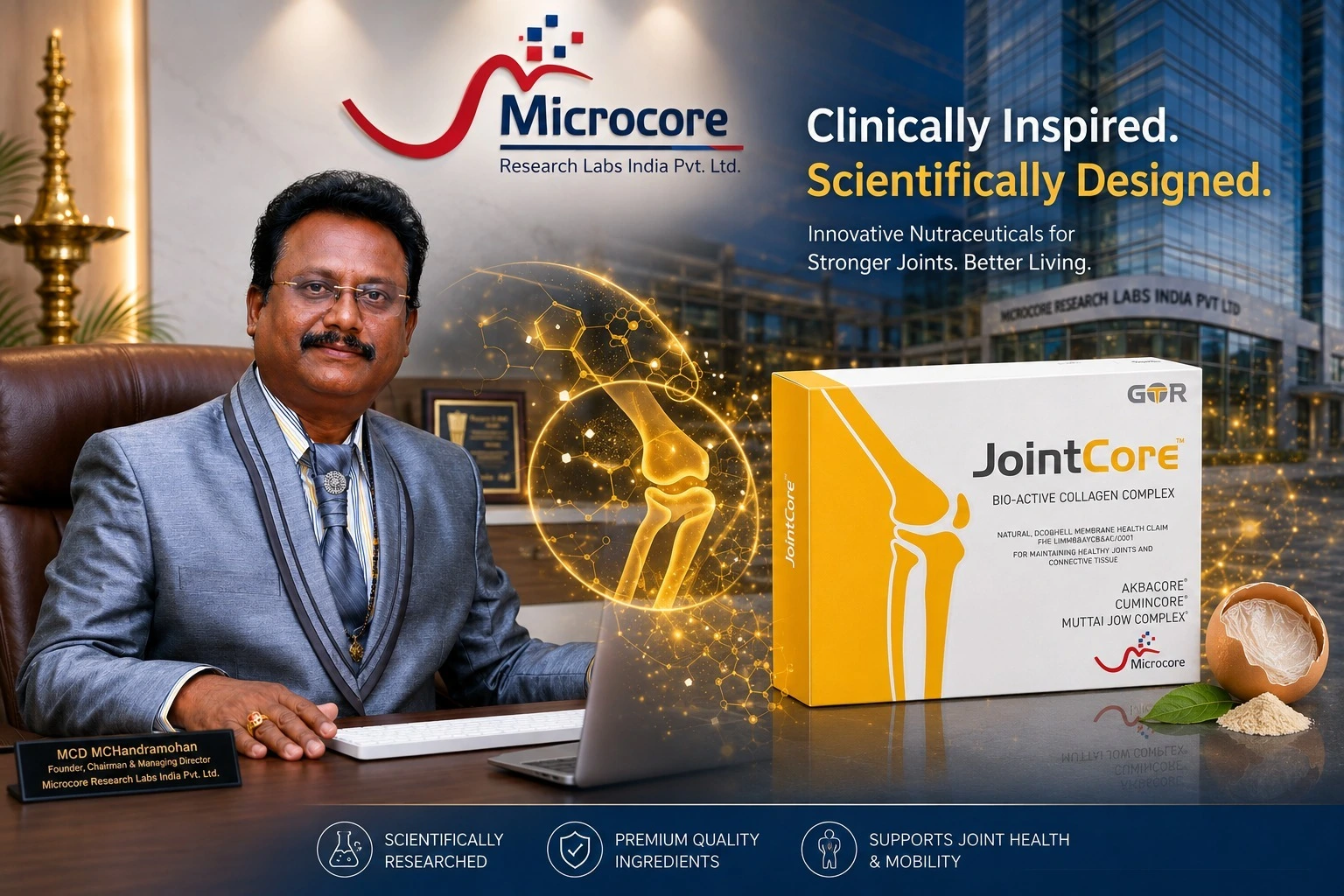
Microcore Research Laboratories India Pvt. Ltd. has pioneered a patented technology to preserve the native structural integrity of NESM, resulting in MuttaiJow Complex®, an advanced biomaterial clinically validated in osteoarthritis patients. This innovation has culminated in JointCore®, a novel nutraceutical formulation combining MuttaiJow Complex®, AKBACORE® (Boswellia serrata extract standardized to 30% AKBA), and CUMINCORE® (96% Curcumin extract). Clinical studies have demonstrated efficacy comparable to conventional diacerein-based therapy while offering an improved safety profile and enhanced gastrointestinal tolerability.
This article reviews the scientific basis of NESM technology, clinical evidence supporting JointCore®, and the future role of biomaterial-based regenerative nutraceuticals in musculoskeletal medicine.
INTRODUCTION
Osteoarthritis is no longer considered merely an age-related disease. It is now recognized as a multifactorial disorder involving chronic inflammation, progressive cartilage degeneration, extracellular matrix destruction, subchondral bone remodeling, oxidative stress, and synovial dysfunction. These pathological changes gradually impair joint function, resulting in chronic pain, stiffness, reduced mobility, and diminished quality of life.
According to the Global Burden of Disease Study, nearly 600 million people worldwide were living with osteoarthritis in 2020, and the number is projected to rise substantially by 2050 due to increasing life expectancy, obesity, sedentary lifestyles, and metabolic disorders. In India alone, arthritis affects more than 210 million people, with osteoarthritis accounting for the majority of cases. Women above the age of 55 years are particularly vulnerable because of hormonal changes associated with menopause, reduced bone density, and altered collagen metabolism.
The socioeconomic impact of osteoarthritis is profound. It is one of the leading causes of disability, work absenteeism, healthcare expenditure, and reduced productivity. As populations continue to age globally, there is an urgent need for therapeutic strategies that not only alleviate symptoms but also preserve joint structure and function.
Traditional pharmacological management largely focuses on pain control using NSAIDs, corticosteroids, glucosamine, chondroitin sulfate, and diacerein. While these agents may reduce inflammation and improve mobility temporarily, they do not regenerate damaged cartilage or restore the extracellular matrix. Long-term administration is often limited by gastrointestinal irritation, hepatotoxicity, nephrotoxicity, and cardiovascular risks. Consequently, clinicians and researchers are increasingly exploring biologically active nutraceuticals capable of modulating disease pathways while maintaining excellent safety profiles.
Among these innovations, Natural Egg Shell Membrane has emerged as one of the most promising biomaterials in regenerative nutraceutical science because of its unique molecular composition and ability to support connective tissue repair.
MICROCORE RESEARCH LABORATORIES: PIONEERING BIOMATERIAL INNOVATION
Founded in 2007, Microcore Research Laboratories India Pvt. Ltd. has established itself as one of India’s leading biotechnology companies dedicated to the development of clinically validated functional biomaterials and advanced nutraceutical ingredients. Under the leadership of M. Chandra Mohan, the company has built an integrated research ecosystem spanning microbiology, biomaterials engineering, nutraceutical formulation, fermentation technology, and translational clinical research.
Recognizing the limitations of conventional nutraceutical ingredients, Microcore embarked on an ambitious mission to develop indigenous biomaterials capable of delivering measurable clinical benefits. Over nearly a decade of intensive research, the company designed and patented a proprietary extraction and stabilization technology that preserves the native extracellular matrix structure of Natural Egg Shell Membrane.
Unlike conventional processing methods that expose the membrane to harsh chemical or thermal conditions—resulting in denaturation of collagen fibers and degradation of elastin and glycosaminoglycans—Microcore’s technology maintains the biological integrity of these critical structural proteins. This achievement led to the development of MuttaiJow Complex®, a structurally conserved biomaterial that retains the synergistic interactions among collagen, elastin, hyaluronic acid, chondroitin sulfate, dermatan sulfate, keratan sulfate, glucosamine, and bioactive peptides.
The scientific significance of this innovation extends beyond ingredient preservation. By maintaining the natural extracellular matrix architecture, MuttaiJow Complex® provides a biomimetic scaffold capable of supporting tissue homeostasis, reducing inflammatory signaling, and promoting connective tissue resilience.
This indigenous technology has positioned Microcore among a select group of global innovators in biomaterial science while contributing to India’s self-reliance in advanced nutraceutical research and reducing dependence on imported functional ingredients.
Natural Egg Shell Membrane (NESM): The Science Behind a Next-Generation Biomaterial Understanding the Biology of Natural Egg Shell Membrane
Nature has evolved highly sophisticated biological materials that provide structural strength, elasticity, and regenerative capacity. One such remarkable biomaterial is the Natural Egg Shell Membrane (NESM), a thin yet highly organized extracellular matrix located between the eggshell and the egg white. Although often regarded as a by-product of the poultry industry, modern biomaterial research has revealed that this membrane is a rich reservoir of structural proteins, glycosaminoglycans, and bioactive molecules that collectively support connective tissue health.
Unlike conventional collagen supplements that typically deliver a single purified protein, NESM retains a naturally integrated extracellular matrix in which multiple structural and functional components coexist in a biologically coordinated manner. This unique composition enables a synergistic mode of action that is difficult to replicate using isolated ingredients.
The scientific interest in NESM stems from its ability to provide structural proteins, signaling peptides, and extracellular matrix molecules in their native configuration, thereby supporting the physiological maintenance of cartilage, ligaments, tendons, skin, bone, and other connective tissues.
A Complete Extracellular Matrix in a Single Natural Ingredient
Natural Egg Shell Membrane contains a highly organized network of biologically active components, including:
- Collagen Type I
- Collagen Type III
- Collagen Type V
- Collagen Type X
- Elastin
- Hyaluronic Acid
- Chondroitin Sulfate
- Dermatan Sulfate
- Keratan Sulfate
- Endogenous Glucosamine
- Sulfur-containing compounds
- Functional bioactive peptides
Rather than acting independently, these molecules function together within a preserved extracellular matrix scaffold. This structural organization contributes to improved biological activity compared with isolated collagen preparations.
The Clinical Importance of Multiple Collagen Types
One of the defining characteristics of NESM is the presence of several physiologically important collagen subtypes.
Collagen Type I
Collagen Type I is the most abundant collagen in the human body. It forms the structural framework of:
- Bone
- Tendons
- Ligaments
- Skin
- Blood vessels
- Connective tissues
It provides tensile strength and mechanical stability while supporting tissue repair following injury or degeneration.
Collagen Type III
Collagen Type III forms delicate reticular fibers that contribute to tissue elasticity and flexibility. It is especially important in:
- Blood vessels
- Skin
- Internal organs
- Early wound healing
- Soft connective tissues
During tissue regeneration, Type III collagen is synthesized before gradual remodeling into mature Type I collagen, making it essential for repair processes.
Collagen Type V
Although present in smaller quantities, Type V collagen plays a critical regulatory role by controlling collagen fibril formation and organization. It contributes to:
- Hair follicle integrity
- Placental tissues
- Corneal structure
- Dermal extracellular matrix
Its interaction with Type I collagen helps maintain proper tissue architecture and mechanical properties.
Collagen Type X
Collagen Type X has particular relevance in osteoarthritis because it is closely associated with cartilage metabolism and endochondral ossification.
It participates in:
- Cartilage mineralization
- Chondrocyte differentiation
- Osteochondral remodeling
- Maintenance of joint integrity
The presence of Type X collagen distinguishes NESM from many conventional collagen supplements that primarily provide Types I and III.
Elastin: Restoring Flexibility
Collagen provides strength, whereas elastin provides elasticity.
Elastin allows connective tissues to stretch and recover without permanent deformation. It is abundant in:
- Ligaments
- Blood vessels
- Skin
- Lungs
- Joint-supporting tissues
Microcore’s proprietary processing technology is designed to preserve mature elastin cross-links, helping maintain the structural resilience of the extracellular matrix.
Hyaluronic Acid: The Natural Lubricant
Hyaluronic acid is an essential component of synovial fluid and connective tissue. Its biological functions include:
- Joint lubrication
- Shock absorption
- Cartilage hydration
- Nutrient transport
- Tissue repair
Loss of hyaluronic acid is a common feature of osteoarthritis and contributes to joint stiffness and reduced mobility. By naturally containing hyaluronic acid within its extracellular matrix, NESM offers a biologically relevant source of this important molecule.
Glycosaminoglycans: Building the Cartilage Matrix
Natural Egg Shell Membrane also contains sulfated glycosaminoglycans such as:
- Chondroitin sulfate
- Dermatan sulfate
- Keratan sulfate
These molecules attract and retain water within cartilage, enabling it to resist compressive forces during movement. They also contribute to extracellular matrix organization and interact with collagen fibers to maintain tissue integrity.
Bioactive Peptides and Endogenous Glucosamine
During physiological digestion, NESM releases bioactive peptides that may participate in cellular signaling involved in connective tissue maintenance. In addition, endogenous glucosamine present within the membrane contributes to the natural synthesis and turnover of cartilage matrix components.
This integrated biochemical profile distinguishes NESM from formulations that rely on high-dose supplementation with isolated glucosamine or chondroitin alone.
Why Structural Preservation Matters
Not all egg shell membrane ingredients are biologically equivalent.
Conventional manufacturing methods that employ excessive heat, harsh chemicals, enzymatic hydrolysis, or mechanical shear may alter collagen conformation, disrupt elastin architecture, and degrade glycosaminoglycans. Such changes can reduce the structural integrity of the extracellular matrix and potentially diminish biological functionality.
Recognizing this challenge, Microcore Research Laboratories developed a proprietary stabilization process that aims to preserve the native architecture of the membrane during manufacturing. The resulting ingredient, MuttaiJow Complex®, is designed to maintain the natural interaction among collagen fibers, elastin, glycosaminoglycans, and associated biomolecules while supporting manufacturing consistency and quality.
MuttaiJow Complex®: An Indigenous Biomaterial Innovation
MuttaiJow Complex® represents the culmination of years of research in biomaterials engineering and nutraceutical process technology.
Its distinguishing characteristics include:
- Preservation of the native extracellular matrix architecture.
- Retention of multiple collagen subtypes.
- Maintenance of elastin integrity.
- Conservation of glycosaminoglycans and hyaluronic acid.
- Standardized manufacturing designed for consistent quality.
- Development through an indigenous Indian biotechnology platform.
This approach reflects a broader movement toward biomaterial-based nutraceuticals that seek to support tissue homeostasis using naturally integrated biological matrices rather than isolated nutrients.
A Platform Technology Beyond Osteoarthritis
Although initial clinical development has focused on osteoarthritis, the biological composition of Natural Egg Shell Membrane suggests potential applications in several areas of regenerative nutrition and connective tissue support, including:
- Healthy aging
- Bone health
- Sports medicine
- Tendon and ligament support
- Skin elasticity
- Hair follicle support
- Wound healing
- Post-surgical recovery
Continued clinical investigation will help define the role of NESM-based biomaterials across these emerging applications.
Conclusion
Natural Egg Shell Membrane represents an important advancement in biomaterial science by providing a naturally integrated extracellular matrix rich in collagens, elastin, glycosaminoglycans, hyaluronic acid, and bioactive peptides. Through proprietary processing technologies designed to preserve this native structure, biomaterials such as MuttaiJow Complex® illustrate how modern biotechnology can harness natural matrices to support connective tissue health. This scientific foundation sets the stage for the clinical evaluation of JointCore®, which is discussed in the next section.