
Higher education is undergoing a profound transformation. As technology reshapes industries, sustainability becomes an increasingly urgent global priority, and employers seek graduates with a combination of technical expertise, creativity and adaptability, universities are expected to prepare students for challenges that extend well beyond traditional classrooms. In this changing environment, Pandit Deendayal Energy University (PDEU) has established a distinctive identity by bringing together education, research, innovation and industry-oriented learning.
Established in 2007, PDEU has developed into a multidisciplinary university with a strong focus on energy and infrastructure while also offering education across engineering, technology, management, liberal studies, sciences and law. Its vision is to develop into a world-class institution of excellence in energy education, research and innovation while preparing young people and society for sustainable transformation.
The university’s journey reflects an understanding that contemporary education must combine academic rigor with real-world relevance. Through its schools, research initiatives, industry engagement and student development activities, PDEU seeks to create graduates who are not only employable but also capable of becoming innovators, researchers, entrepreneurs and leaders.
A University Built Around a Distinctive Vision
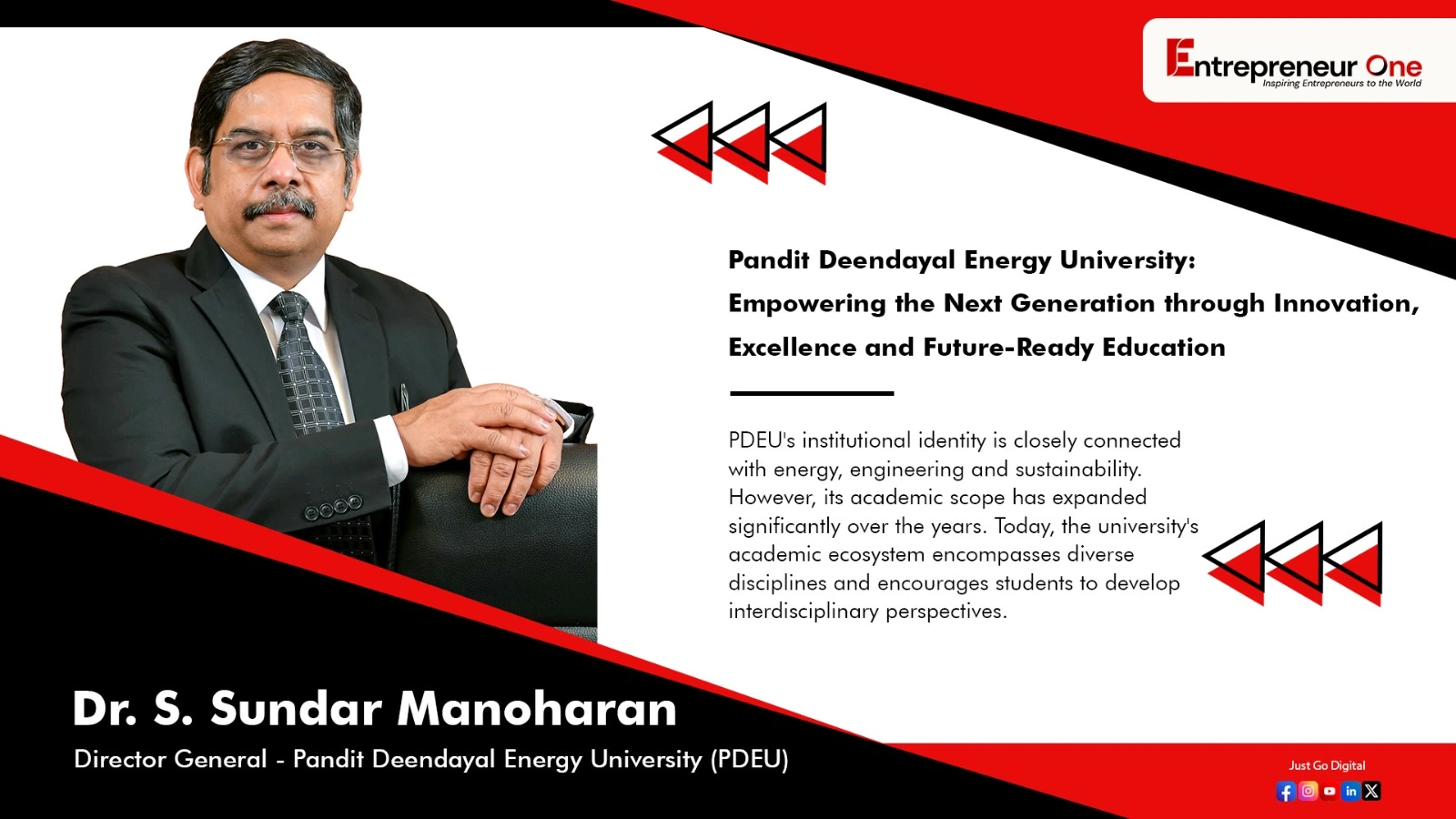
PDEU’s institutional identity is closely connected with energy, engineering and sustainability. However, its academic scope has expanded significantly over the years. Today, the university’s academic ecosystem encompasses diverse disciplines and encourages students to develop interdisciplinary perspectives.
The university operates through specialized schools and academic units, including the School of Energy Technology, School of Technology, School of Management, School of Liberal Studies, alongside its newer academic initiatives such as the School of Law. PDEU’s academic portfolio includes undergraduate, postgraduate and doctoral education across a range of disciplines. Its official course portfolio includes programs such as B.Tech., M.Tech., BA, MA, BBA, MBA, B.Com., B.Sc., M.Sc. and Ph.D. opportunities, while newer offerings continue to broaden the university’s academic landscape.
The university’s recent expansion into legal education further demonstrates its commitment to responding to changing educational and professional needs. Its School of Law commenced programs including the five-year B.A. LL.B. and three-year LL.B. from the 2025-26 academic year.
This multidisciplinary approach is particularly relevant in a world where complex problems rarely fit within the boundaries of a single discipline.
Leadership With a Focus on Institutional Transformation
Strong institutions are shaped by strong leadership. At PDEU, senior academic and administrative leaders are responsible for translating the university’s broader vision into measurable academic, research and institutional outcomes.
The leadership team’s responsibilities encompass academic planning, faculty development, student welfare, research, infrastructure, industry engagement, internationalization and institutional growth. Rather than viewing these areas independently, the university’s approach emphasizes their interconnection.
Effective leadership in higher education today requires anticipating change rather than simply responding to it. For PDEU, this means understanding emerging areas of technology and energy, recognizing the changing expectations of employers, strengthening research capabilities and creating an environment where students and faculty can experiment with new ideas.
The university’s NAAC A++ accreditation, Centre of Excellence status awarded by the Government of Gujarat, and accreditation of several B.Tech. programs by the National Board of Accreditation reflect its continuing emphasis on academic quality and institutional standards.
These achievements are not simply recognitions; they also create a responsibility to maintain and improve academic standards.
Academic Programs That Connect Knowledge With Application
Aligned with the vision of Atmanirbhar Bharat and India’s national mission of Viksit Bharat @2047, PDEU is committed to nurturing future-ready professionals, researchers, entrepreneurs and innovators who can contribute meaningfully to India’s journey towards becoming a developed, self-reliant and sustainable nation.
A modern energy challenge, for instance, may require expertise in engineering, economics, management, public policy, environmental studies and data science. Preparing students to understand these intersections can give them a valuable advantage in a rapidly changing employment landscape.
In the pursuit to equip the students with Industry readiness, the University has revamped the entire course curriculum with Industry 4.0 demands. The University has included Mixed/Augmented/Virtual Reality, Industry IoT, Cyber-Physical System, Artificial Intelligence, Blockchain Technology, Additive Manufacturing, Smart Energy Storage System, Automotive Manufacturing, Automotive Electronics, Electric Vehicles, Biomedical Engineering, Nanotechnology, Targeted Drug Delivery, and Machine Learning in the syllabus. It will be the hub for effective translation of research and innovative ideas into sustainable solutions in the areas of energy, health, water and Climate change.
PDEU’s biotechnology program and BSL-3 facility on campus combines engineering and biological sciences and emphasizes areas such as bioinformatics, bioprocessing, recombinant DNA technology and bio-entrepreneurship.
Its commitment to Atmanirbhar Bharat and Viksit Bharat @2047 is reflected in its endeavour to develop homegrown technologies, empower future innovators and create impactful solutions that contribute to national development and global sustainability.
Faculty-Student Interaction: Making Learning More Personal
A university’s infrastructure and curriculum are important, but the quality of interaction between students and educators remains central to meaningful learning.
PDEU’s academic philosophy places considerable importance on mentoring and faculty engagement. The university’s published institutional material emphasizes the development of students’ technological, intellectual and moral capabilities and the creation of future leaders and innovators.
A healthy student-to-faculty ratio contributes significantly to this objective by allowing educators to understand students’ academic requirements and provide more individualized guidance. Beyond classroom teaching, faculty members support students through mentoring, research projects, internships, career planning and participation in academic activities.
For students, this creates an environment in which education becomes more interactive and collaborative rather than being limited to lectures and examinations.
Empowering Startups and Entrepreneurs
Innovation thrives in an ecosystem that supports startups and entrepreneurship, and PDEU excels in fostering such an environment. The university’s Innovation Council has nurtured over 240 startups, many of which focus on renewable energy and storage solutions. These initiatives have not only generated significant revenue but also driven impactful projects like solar trees and mobile battery chargers for electric vehicles. PDEU’s holistic support system spans from ideation to scaling, offering funding, mentorship, and industry connections. This comprehensive approach ensures that innovative ideas transition smoothly into viable businesses, contributing to India’s renewable energy goals and the broader vision of ‘Atmanirbhar Bharat’ (self-reliant India).
PDEU IIC has also been approved to be a “Technology Business Incubator”, a recognition by the Department of Science and Technology, Government of India. It is recognized as a Nodal Institute by the Government of Gujarat. PDEU IIC has incubated 240+ start-ups across 10+ domains and generated 500+ employment opportunities through start-ups. The IIC Office has a specially designated area of 20,000 sq. ft for the start-ups to work on.
Responding to the New Era of Higher Education
PDEU is building itself as a “Pre-Industry” University: a campus that de-risks technologies before industry invests, trains industry-ready manpower, and hosts pilot-scale facilities where ideas are proven at realistic scale. Its 45 MW solar PV module manufacturing line replicates a commercial factory, with stringer machines, lamination presses and electroluminescence testers, so students learn by producing real modules and manufacturers can trial new processes before scaling them. The NSDC–PDEU Centre of Excellence, inaugurated in April 2025, adds a semiconductor packaging (ATMP) training unit that prepares technicians in back-end assembly and chip encapsulation for plants such as Micron’s at Sanand, alongside more than 40 courses in VLSI, AI and smart manufacturing. The India–Australia Rooftop Solar Training Academy, which began its first cohort in July 2026, will train 2,000 rooftop solar technicians and helpers to Australian standards in support of PM Surya Ghar: Muft Bijli Yojana. Together, these facilities let PDEU build the factory, the skills and the test bed first, so industry can scale with confidence.
PDEU’s energy-focused heritage and industry-academia collaboration gives it a natural platform from which to engage with several of these developments. Energy transition, renewable energy, climate change, advanced materials, biotechnology, artificial intelligence and data-driven decision-making are increasingly interconnected fields.
The objective is not simply to introduce new technologies into classrooms but to help students understand how technology can be used responsibly to solve real-world problems.
PDEU is thriving to recognize the potential of students’ bright mind by bringing out several schemes to safe guard students and faculties’ IPR. To help stakeholders with their IPR activities, PDEU offers three stage research grants and also guides them in securing their IPR specially design patent, product process patent, and copyright. It encourages students to interact with the global scientific community by supporting their paper presentations in various national and international conferences.
Creating a Supportive Campus Culture
Students perform best when they feel supported academically, socially and personally. PDEU’s institutional ecosystem includes facilities and initiatives related to student welfare, counselling, grievance redressal, anti-ragging measures and student activities.
PDEU provides its learners with a perfect blend of pristine environment and modern technology, enabling a dynamic learning experience and turning students into potential professionals. The university has an excellent infrastructure with proper maintenance facilities offering students an ideal platform for excelling their performance. Be it festivals, sports, or various programs/events, the students actively participate and win awards for the university, with more than 40 student clubs. The students take an active role in the club functioning as a Core Executive Member and also participate in the activities organised by other clubs. There are 3 major annual festivals: Flare, Tesseract, and Energy Cup, which are organised annually where students from different colleges across the country participate.
The Road Ahead: Expansion, Innovation and New Opportunities
PDEU’s future is likely to be shaped by the same forces influencing higher education globally: technological transformation, sustainability, interdisciplinary research and changing workforce requirements.
The university’s continuing expansion of academic programs, including its newer School of Law, illustrates its willingness to diversify while retaining its core institutional strengths.
Future development can be expected to focus on strengthening academic infrastructure, expanding research capabilities, introducing contemporary programs, enhancing laboratories and technology-enabled learning environments, and developing stronger national and international collaborations.
The objective should not be growth for its own sake. Every new program, facility or initiative must ultimately contribute to the university’s fundamental purpose—creating greater opportunities for students to learn, innovate and contribute to society.
Advice for Students Considering PDEU
For students considering PDEU, the most important advice is to look beyond the degree itself. University is a period of exploration, experimentation and personal development.
Students should take advantage of opportunities to interact with faculty, participate in research, undertake internships, develop projects, join student activities and explore disciplines beyond their immediate curriculum.
The future belongs to graduates who can combine specialized knowledge with communication, creativity, critical thinking, collaboration and adaptability. A university can provide the ecosystem, but students must actively engage with it.
At PDEU, students have the opportunity to learn in an environment where energy, technology, management, liberal education, research and innovation intersect. Making the most of that environment requires curiosity and a willingness to continuously learn.
A Vision for Education and Sustainable Transformation
At its core, PDEU’s vision goes beyond producing graduates. The university seeks to nurture individuals capable of contributing to technological advancement, sustainable development and social progress.
Its emphasis on energy education, research and innovation gives it a distinctive role at a time when India and the world are navigating major transitions in energy, technology and sustainability. At the same time, its expanding multidisciplinary academic portfolio reflects the understanding that tomorrow’s challenges will require professionals who can think across traditional boundaries.
PDEU’s journey demonstrates how a university can preserve a distinctive identity while adapting to the evolving demands of higher education. By investing in academic excellence, faculty, research, innovation and student development, the institution is positioning itself not merely to respond to the future but to help shape it.
The ultimate measure of any university is the impact it creates through its students, faculty, research and contribution to society. With its focus on education, innovation and sustainable transformation, Pandit Deendayal Energy University is building an academic ecosystem designed to empower the next generation to think boldly, act responsibly and lead meaningfully in a rapidly changing world.